Black Widow Spider Identification: Female, Male, Juvenile and Lookalikes, With Pictures
A black widow female is glossy black with a red hourglass under a round abdomen. Males, juveniles and brown widows look different, and false widows look similar. Photos, a lookalike table and what a bite feels like.
Not sure what you found? Identify it from a photo, freeA female black widow is a glossy, jet-black spider with a large round abdomen and a red or orange hourglass on the underside. Her body is about 8 to 13 mm long, roughly 25 to 38 mm with the legs spread, and she hangs upside down in a messy tangle web close to the ground: in woodpiles, sheds, garages, meter boxes and under outdoor furniture. If your spider is shiny black, round-bodied and shows a red hourglass when it hangs in its web, it is a widow.
Most mix-ups happen because the other widows look different: males and juveniles are small and striped, the brown widow is light brown, and the milder "false widows" are dark and round but have no hourglass. Photos of each below.
Black widow at a glance
Sizes are body length without legs.
| Size | Colour | Key mark | Bite | |
|---|---|---|---|---|
| Adult female black widow | 8 to 13 mm | Shiny black | Red or orange hourglass underneath; some have red spots on top | Medically important: cramps and pain within hours |
| Male black widow | 3 to 6 mm | Brown to black, slim, long legs | Red, white and yellow stripes or spots on top of the abdomen | Not dangerous |
| Juvenile black widow | 2 to 7 mm | Tan to grey with white and orange bands | Pale hourglass underneath, striped back | Young females can bite as they near adult size |
| Brown widow | 7 to 10 mm (female) | Tan to dark brown, mottled | Orange hourglass underneath, banded legs, spiky egg sacs | Painful but rarely more than local |
| False black widow (Steatoda grossa) | 6 to 10 mm | Purple-brown to black, slightly duller | No hourglass; faint pale marks or none | Mild, like a wasp sting |
| Noble false widow (Steatoda nobilis) | 9.5 to 14 mm (female) | Brown to dark brown | Cream "skull" or blotch pattern on top, no hourglass | Painful, like a wasp sting; occasionally infected |
Female black widow: the one that matters
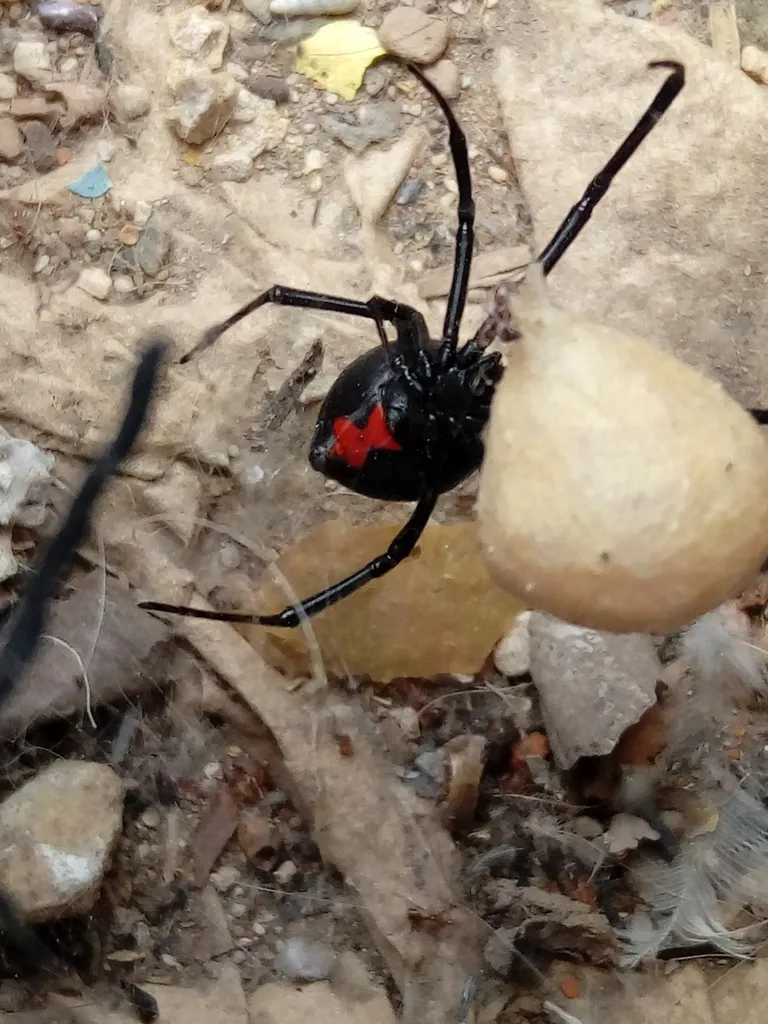
Field marks of an adult female:
- Glossy, almost lacquered black. Not hairy, not velvety. Some individuals are very dark brown.
- Big round abdomen, much larger than the front body section, like a shiny pea or small marble.
- Hourglass underneath. Red or orange, sometimes broken into two separate triangles. You see it when she hangs belly-up in the web, not when she sits on a wall.
- Long, thin, all-black legs, without bands or hairs.
- A messy web of strong, sticky, criss-crossing threads near the ground, usually with a retreat in a crack or hole. The silk feels noticeably tough when you break it.
North America has three black widows. The southern black widow (Latrodectus mactans) lives across the Southeast and has a complete hourglass, often with a red spot just above the spinnerets. The western black widow (L. hesperus) covers the western US and Canada and looks almost identical. The northern black widow (L. variolus) lives in the Northeast and Great Lakes; its hourglass is usually split into two parts, and it often has a row of red spots along the top of the abdomen. Elsewhere, close relatives include the redback in Australia (red stripe on top), the katipō in New Zealand and the Mediterranean black widow in southern Europe.
Male black widow
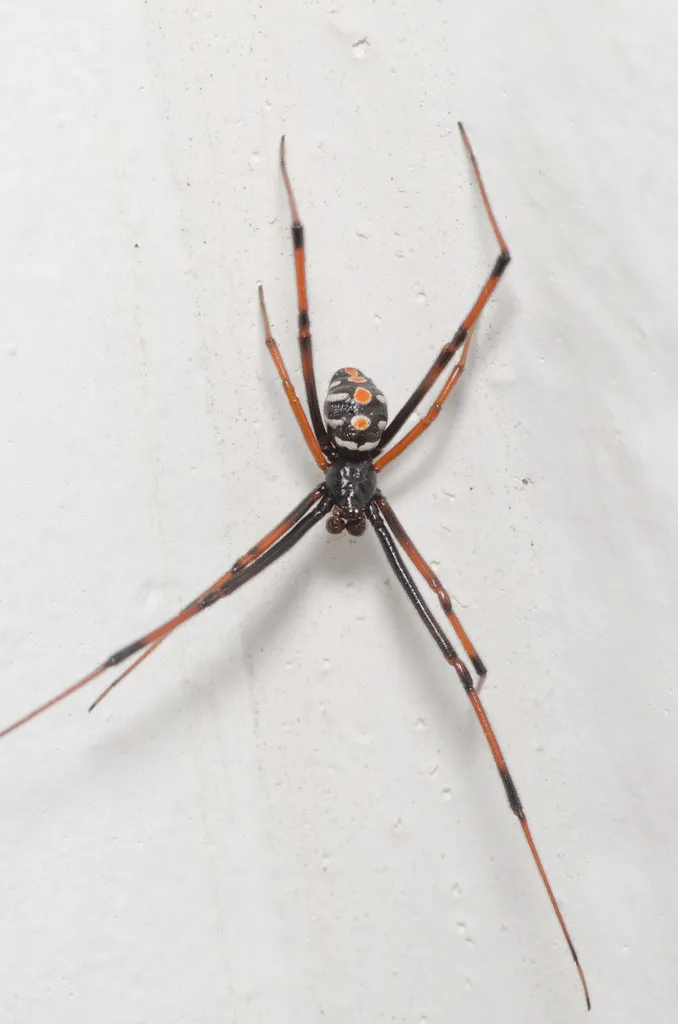
Adult males are about half the length of a female and much thinner, with long, often banded legs and red, white or yellow stripes and spots on top of the abdomen. They wander walls and garages in summer looking for females. Only female widows are considered dangerous to people.
Juvenile black widow
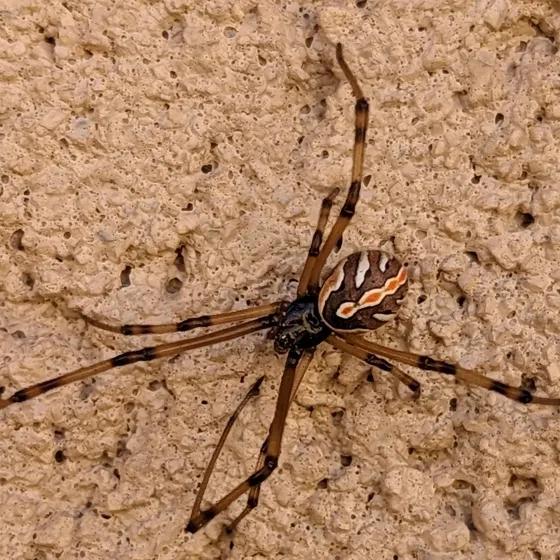
Spiderlings hatch nearly white. Over several moults they turn tan, then grey or brown with white and orange bands on top, and finally black. A juvenile already has an orange or yellowish hourglass underneath. A striped, round-bodied spider in a tough tangle web where a black widow would live is probably a young widow; treat larger ones like an adult female.
Brown widow
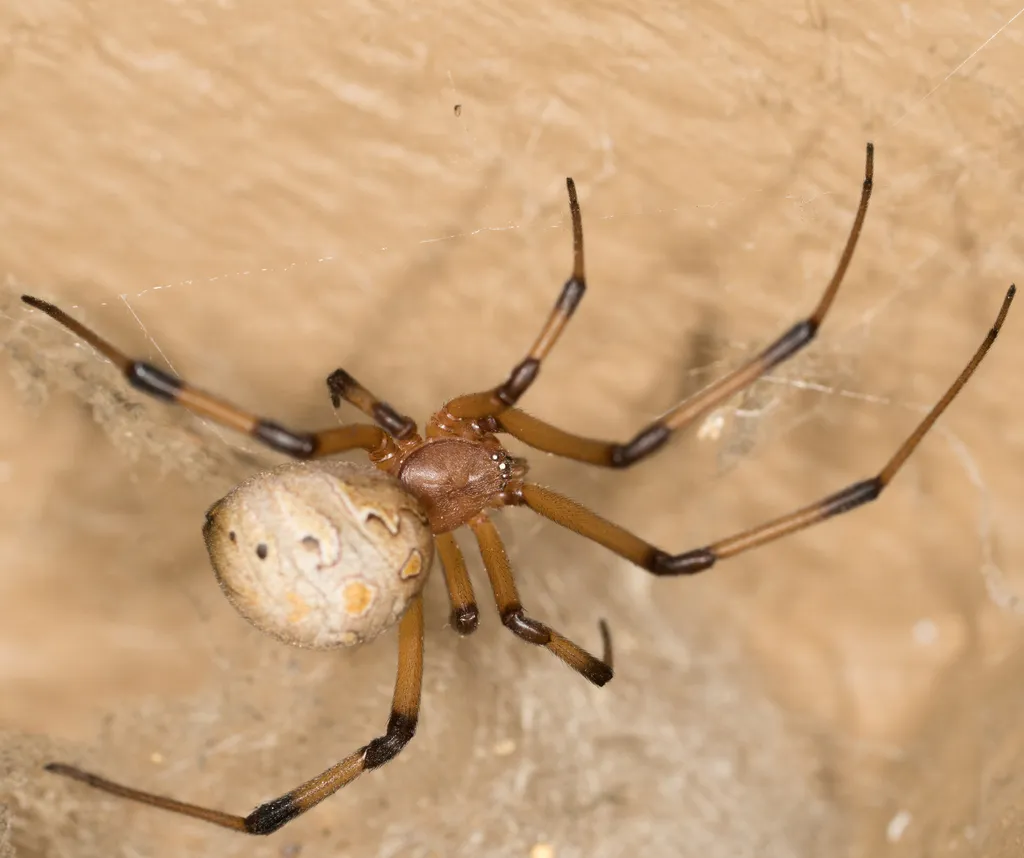
The brown widow is a true widow, introduced to the US and now common in Florida, along the Gulf Coast and in southern California, as well as in Hawaii, Australia, South Africa and many warm countries. It is lighter in colour than a black widow, with a mottled grey-to-brown abdomen, legs banded dark at the joints, and an orange hourglass underneath. It favours man-made spots: under patio chairs, in mailboxes and in outdoor toys.
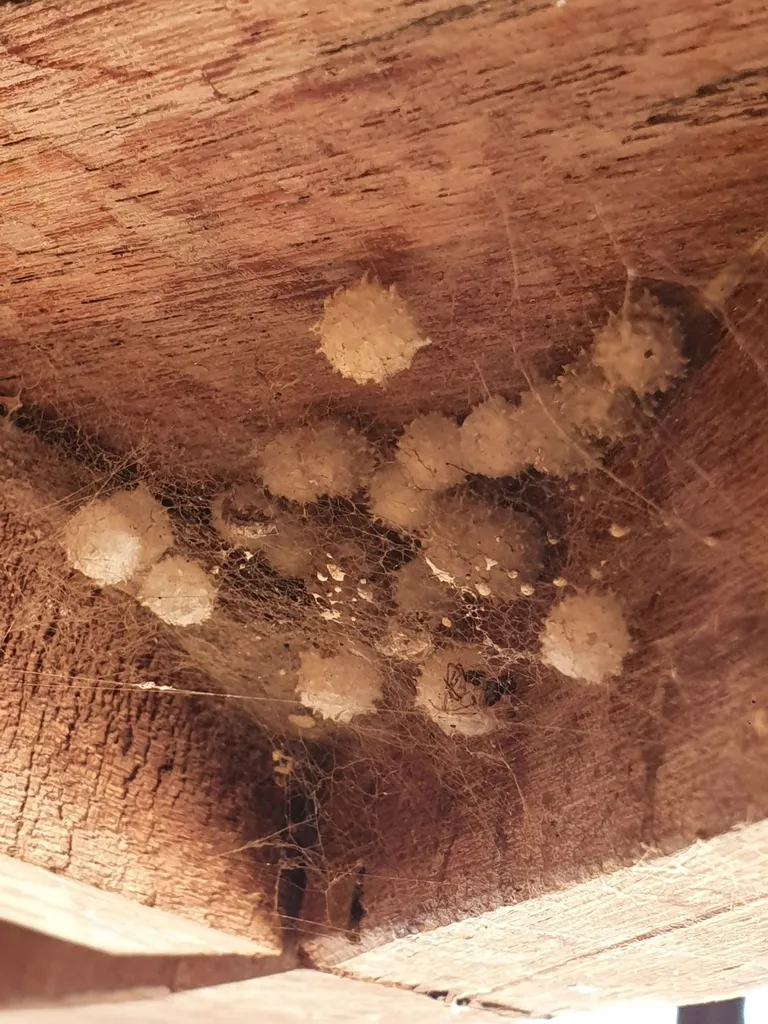
Its venom is similar, but it injects much less; bites are usually painful only at the spot.
Spiders that look like black widows
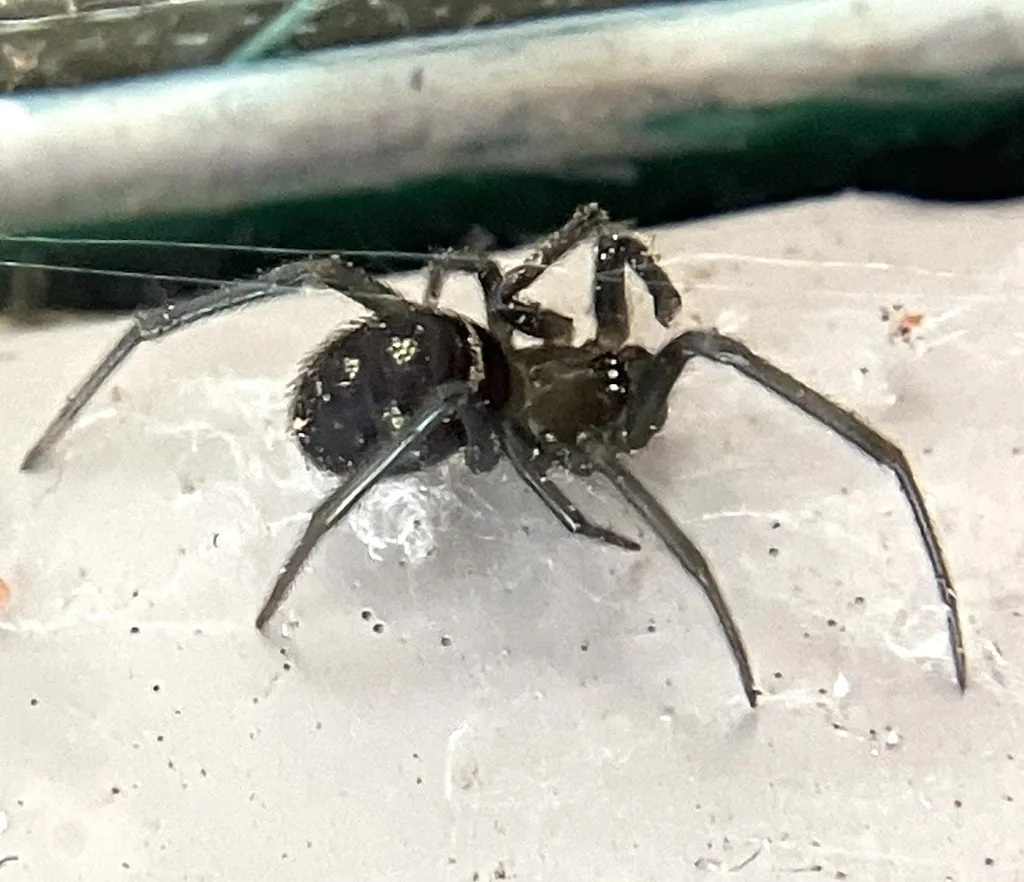
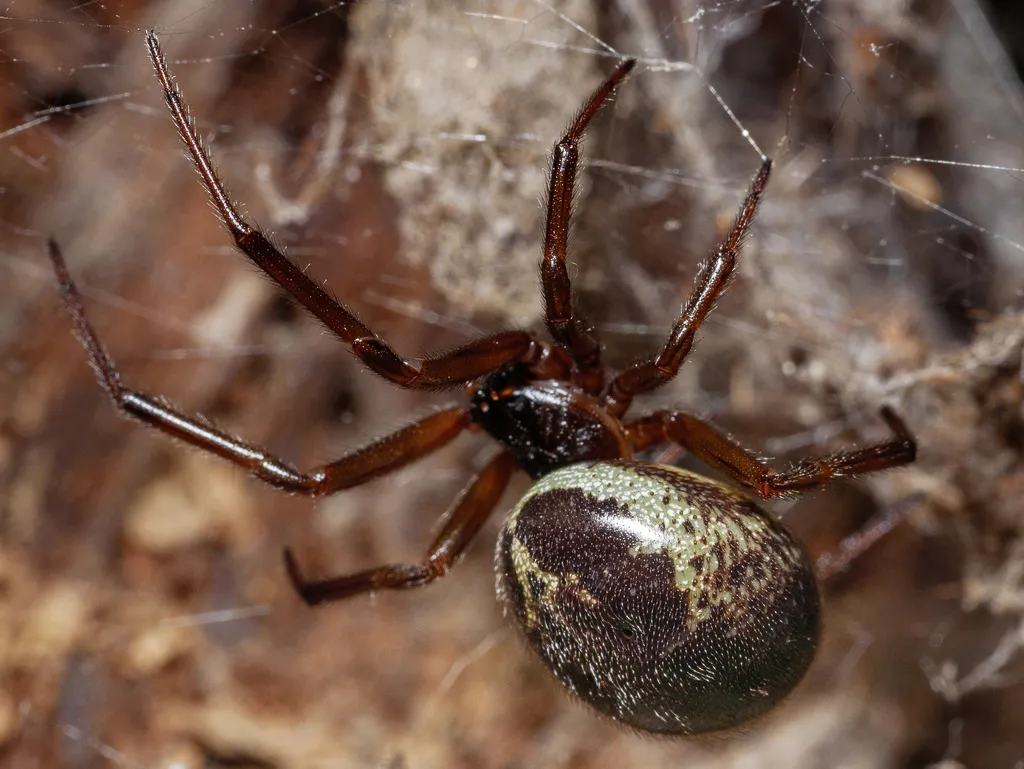
Most "black widows" people find indoors are false widows (Steatoda). They belong to the same family, build the same kind of tangle web and have the same round abdomen, but they have no red hourglass. How to tell them apart:
- Turn it over (with a jar, not a hand). A red or orange hourglass or two red triangles means a widow. No mark, or only pale specks, means it is not a black widow.
- Shine. Black widows look polished. False black widows are a duller purple-brown and often have a faint pale band at the front of the abdomen.
- Pattern on top. A cream "skull" or marbled pattern on a brown back is a noble false widow.
- Where. A spider in a high corner of a heated room is more likely a false widow; black widows prefer cool, dark spots near ground level, outdoors or in garages and crawl spaces.
Other spiders often confused with black widows:
- Red-backed jumping spiders (black with a red patch on top): they are hairy, stocky and hop; they do not hang in webs.
- Black house spider (Badumna insignis, Australia and NZ): velvety, not glossy, with a lace-like web around a hole. Not a widow.
- Ground spiders and young wolf spiders that are dark and shiny: they run on the floor, do not hang in webs and have no hourglass.
If you are still unsure, a clear top and underside photo usually settles it. Upload it to the free online bug identifier, or use the Bug Identifier app to get the species and whether it is dangerous.
Where black widows live and when you see them
- Range: widow species live across most of the US and southern Canada. They are most common in the South and West.
- Outdoors: woodpiles, stone walls, under rocks and decks, in hollow fence posts, water-meter boxes, irrigation valve boxes, sheds and garden furniture.
- Indoors: garages, basements, crawl spaces, behind stored boxes and, less often, under furniture in quiet rooms.
- When: adults are around year-round in warm areas. Bites are most often reported in summer and early autumn, when people move firewood, garden or reach into stored shoes and gloves.
Black widows are shy and bite mainly when pressed against skin: a hand into a glove, a foot into a boot.
What a black widow bite looks like and feels like
The bite site looks surprisingly minor: a small red mark, sometimes with two faint fang points, and a sharp pinprick feeling or nothing at all. The venom acts on nerves, not skin, so the important signs come later and somewhere else:
- Within 30 minutes to two hours: pain spreading from the bite to the nearest large muscles. A bite on the hand or arm causes chest and shoulder pain; a bite on the leg causes belly and back pain. The belly can become rigid.
- Over the next hours: muscle cramps, sweating (sometimes only around the bite), nausea, headache, restlessness and a raised heart rate and blood pressure.
- Duration: symptoms usually peak within a day and fade over one to three days; weakness can linger longer.
In the US, about 2,500 people a year report a black widow bite to poison centres, many bites are "dry" (no venom), and deaths are very rare. Children, older adults and people with heart conditions are more vulnerable. For an hour-by-hour comparison with an ordinary spider bite and a brown recluse bite, see the spider bite stages guide.
What to do: wash the bite with soap and water, put a cold pack on it and keep the limb still. Take the spider with you in a sealed jar if you can do it safely, or photograph it. Get medical care the same day for any suspected widow bite with spreading pain, cramps, sweating or nausea, and call emergency services for breathing trouble, chest pain or a bitten child. In the US, Poison Control is 1-800-222-1222. Doctors treat the pain and cramps; antivenom exists but is reserved for severe cases.
How to keep black widows away
- Wear gloves to move firewood, stones, pots and stored boxes.
- Shake out shoes, boots and gloves that have been left in a garage or outside.
- Keep firewood off the ground and away from the house wall.
- Clear clutter in garages and sheds, and seal gaps under doors and around pipes.
- Vacuum webs and egg sacs, then empty the vacuum outside. Removing egg sacs matters more than spraying: each one holds a few hundred eggs.
- For a recurring problem, call a pest professional; sprays on open walls do little against a spider hidden in its retreat.
If you are not sure what you found, our is this spider dangerous? check rules out the few that matter in four questions, and the brown recluse identification guide covers the other medically important spider in the US.
Frequently Asked Questions
Do all black widows have a red hourglass?
Adult females almost always have a red or orange mark underneath, but the shape varies: a full hourglass, two separate triangles (common in the northern black widow) or, rarely, only a spot. Males and juveniles have paler or striped patterns, and some widows in other countries have no red at all.
Is a black widow male dangerous?
No. Male black widows are small and slender, and their bite is not known to cause the cramps and pain of a female's bite. Only adult and nearly grown female widows are medically important.
What spider looks like a black widow but has no hourglass?
Usually a false widow (Steatoda): the false black widow or cupboard spider in the US and Europe, or the noble false widow in the UK and Ireland. Both are round-bodied and dark but lack the red hourglass, and their bites feel like a wasp sting.
Is a brown widow more dangerous than a black widow?
No. Brown widow venom is similar, but the spider injects far less of it and bites usually cause only local pain. Brown widows are more common around houses in the southern US, so they are bitten more often.
What does a black widow bite look like after a day?
Often like very little: a small red mark that may have faded. The signs are in the body, not the skin: cramps, belly or chest pain, sweating and nausea. If those appear after a possible bite, see a doctor even if the skin looks normal.
The short version
Glossy black, round abdomen, red hourglass underneath, messy web near the ground: female black widow, worth avoiding and worth a doctor if she bites. Striped and slender: a male or juvenile. Brown with banded legs and spiky egg sacs: brown widow. Dark and round without the hourglass: a false widow. If you are unsure which one you have, a photo and Bug Identifier will tell you in seconds.
Sources: Wikipedia articles on Latrodectus, the brown widow and Steatoda nobilis (sizes, markings, ranges, bite statistics), NHS guidance on insect bites and stings, and the spider bite stages guide for bite timing.

Identify any bug in seconds
Download Bug Identifier and get instant AI-powered identification with danger levels, species profiles, and safety information.

 Scan to get it on your iPhone